From 0 to Committer at Apache Magpie: My Journey & Lessons Learned
Introduction: My Very First Pull Request
On September 12, 2026, I had my first interaction with Jarek with my approach for the issue, then I got a signal to go ahead.
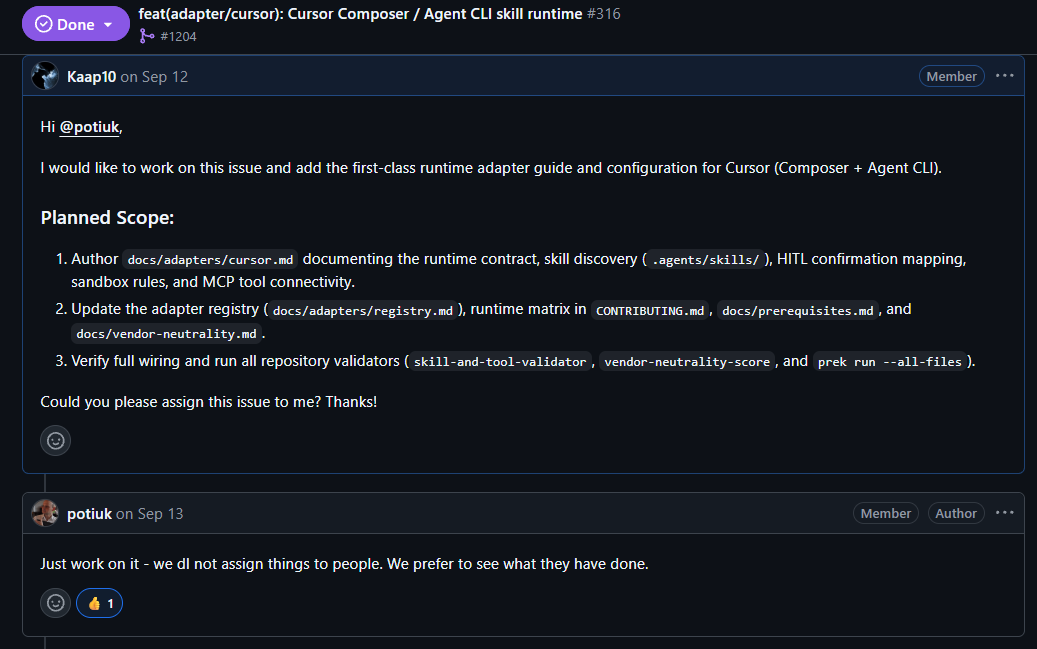
On September 13, 2026, I opened my very first Pull Request on an Apache Software Foundation project: Apache Magpie.
It was PR #1204, a small guide explaining how to run Magpie using the Cursor Composer tool. I opened it and exactly 27 minutes later, I received a notification:
potiukmerged commit38706f8intoapache:main
Jarek Potiuk, a well-known Apache leader and member of the Project Management Committee (PMC), had reviewed and merged my PR in less than half an hour.
As a newcomer, this was an amazing feeling. It gave me a huge boost of confidence. But I also soon realized that this was just the beginning. Opening a small documentation PR is one thing; contributing real code, understanding Apache's strict quality standards, and earning the trust of experienced maintainers is another.
Over the next two months—from September 12 to November 11, 2026
I contributed 35 merged pull requests, performed 37 code reviews to help fellow contributors, went through an eye-opening 8-round code review on a security hook, and eventually earned my invitation to become an Apache Magpie Committer. Along the way, I have met some truly wonderful and welcoming people.
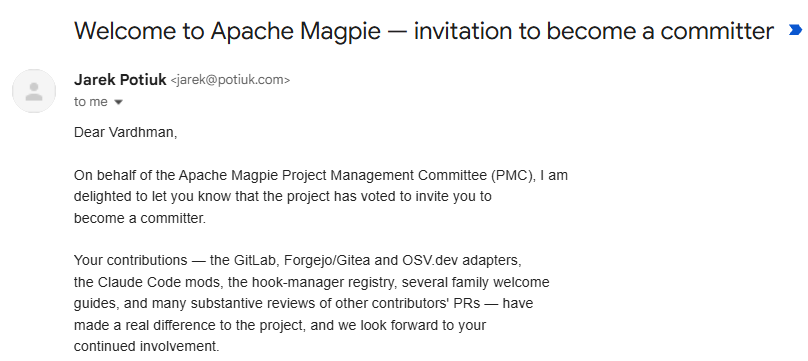
In this post, I want to share my honest journey in simple words: what I built, the mistakes I made, what I learned from Jarek Potiuk, and practical advice for anyone who wants to contribute to open source.
A Quick Overview of the Journey
Here is a simple timeline of my journey between September 13 and November 11, 2026:
- September 13 – 23: Starting out with tool adapters (Cursor, Ollama, Goose, Aider, GitHub Copilot) and learning about Apache testing rules.
- September 24 – October 5: Building the GitLab bridge and learning why being completely honest about what your code can and cannot do matters so much.
- October 6 – 27: Working on Claude Code plugins and going through an 8-round review with Jarek on a security safety check.
- October 28 – November 11: Building interactive terminal user interfaces (review panes, checklist panes) and reaching the committer milestone.
What is Apache Magpie?
The project has a clear motto:
"Give maintainers time back, so they can do what matters."
In open-source software, there is a common problem: enthusiastic contributors keep arriving, but the number of maintainers reviewing pull requests does not scale to match. Maintainers often spend hours every day on repetitive, mechanical tasks—checking license headers, pointing out formatting issues, triaging duplicate bugs, and handling high-stakes security reports.
Apache Magpie was not built to be "just another code-review bot." Its philosophy is much deeper and more human:
- Let machines handle the mechanical chores:
AI agents take care of the repetitive, low-level work—running lint checks, spotting duplicate issues, drafting initial bug categorizations, and pre-flighting changes against repository rules. - Protect human relationships and mentorship:
As Jarek often explains: "Machine-to-machine traffic absorbs the mechanical work; the human relationship is what the platform protects." By clearing away the noise, maintainers and contributors can spend their valuable time talking about real system design, trade-offs, architecture, and learning from each other. That human connection is the foundation that turns first-time contributors into committers, and committers into project leaders. - Safe, high-stakes security handling:
Security issues are the most sensitive and reviewer-intensive part of any project. Magpie gives teams a structured, privacy-conscious workflow to reproduce bugs and prepare fixes without accidentally leaking secret vulnerability details before patches are ready. - Complete vendor neutrality:
Magpie isn't locked to one company, one AI provider, or one platform. It works with GitHub, GitLab, or Forgejo, and supports cloud AI models as well as fully local models running on your own machine.
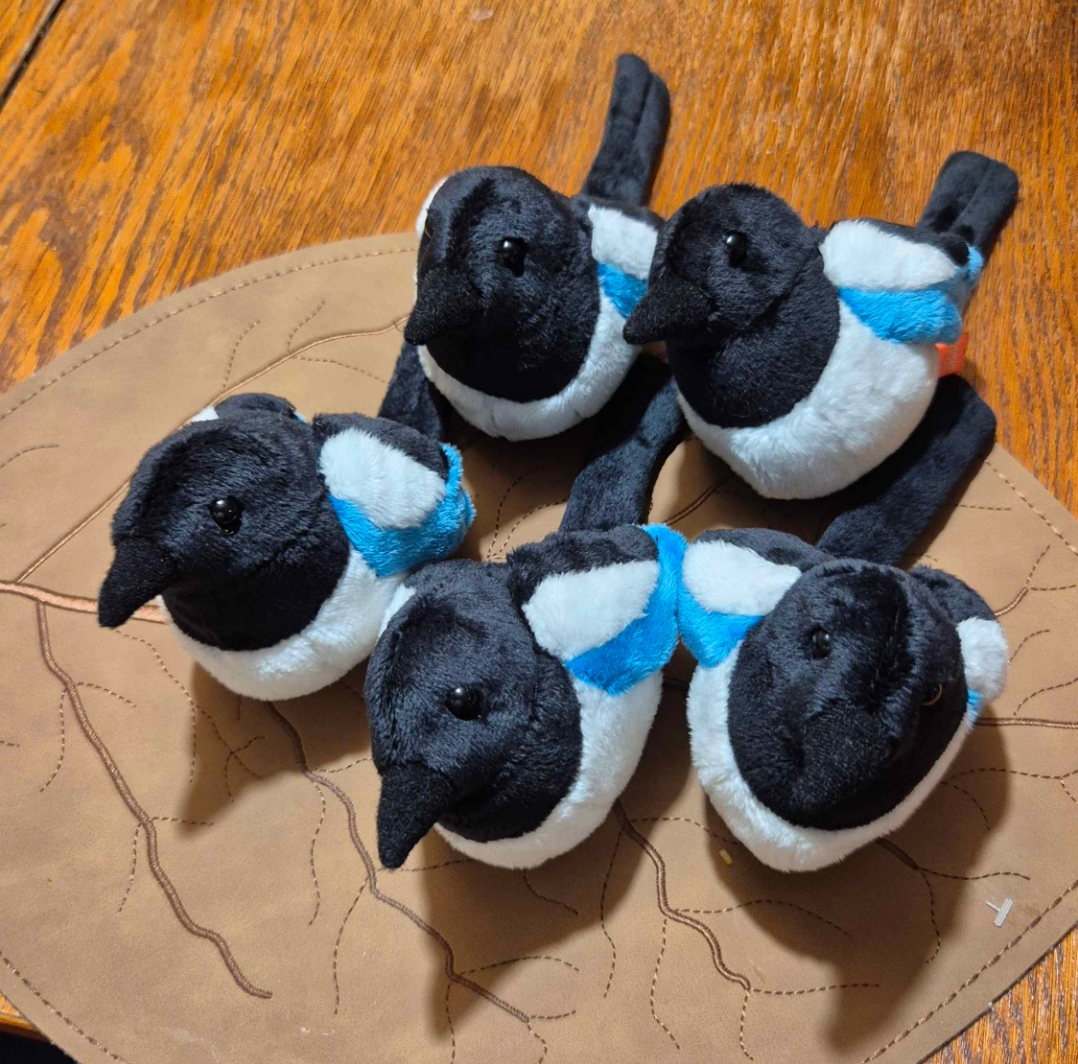
PS: these magpies have more skills than all of us combined :P
Chapter 1: Starting Small with Tool Adapters
(September 13 – September 23, 2026)
When I joined, the project wanted to support different AI coding tools so that developers could choose whatever assistant they liked.
My Early Contributions
I started by writing documentation and setup guides for various tools:
- PR #1204: Cursor Composer and Agent CLI guide (merged in 27 minutes).
- PR #1206: Local AI model setups (Ollama, llama.cpp, vLLM).
- PR #1217: Block's Goose assistant runtime.
- PR #1286: Aider coding assistant guide.
- PR #1287: GitHub Copilot CLI guide.
What I Learned Early On
Even in simple pull requests, Apache projects have very clear standards:
- License Headers (Apache RAT): Every single file, even a small test file or configuration, must have the official Apache 2.0 license text at the top. The automated checks will fail if even one file misses it.
- Automated Formatting and Linting: The repository uses tools like
prekto automatically check code style, Python types, and formatting. Running these locally before pushing saves everyone time.
After getting comfortable with the basics, I decided to take on a bigger challenge: writing real backend code.
Chapter 2: The GitLab Bridge and an Important Lesson in Honesty
(September 24 – October 5, 2026)
On September 24, I submitted PR #1369: adding a bridge to connect Magpie with GitLab.
I wrote the entire tool using only Python's standard library (urllib.request) so users wouldn't need to install extra heavy libraries. I was quite proud of this. However, when maintainers Arnav (@onlyarnav) and Jarek Potiuk (@potiuk) reviewed my PR, they gently pointed out some very important lessons.
Lesson 1: Never Overstate What Your Code Does
In my documentation, I had described the tool as having full support for GitLab issues, code repositories, and merge requests.
Arnav kindly pointed out:
"The code currently only supports 5 read-only operations (reading issues and reading merge requests). It cannot create issues, post comments, or merge pull requests yet. In Apache Magpie, we calculate vendor-neutrality scores. If we mark this as complete, our metrics will be inaccurate. Please mark it as
Coverage: partial."
This was a big lesson for me. In open source, clarity and accuracy are more important than sounding impressive. Being transparent that your code is a good "first step" or "partial implementation" builds trust.
Lesson 2: Watch Out for Hidden Bugs in Edge Cases
Jarek noticed an issue in my pagination logic. If a user asked for 2,000 items (--limit 2000), my code quietly stopped at 1,000 without showing any error or warning to the user.
Jarek explained how to fix it: either fetch all the requested pages or clearly warn the user if a limit is reached.
Lesson 3: Think About the Entire Project, Not Just Your PR
Jarek also pointed out that my PR was missing a generated file (.github/labeler.yml). While my PR passed its own tests, merging it would cause tests on the main branch to fail for everyone else.
He patiently showed me how to run the full repository checks locally. After I fixed all the points, Jarek approved and merged the PR on September 27 with a kind note:
"Everything from the last round is fixed and verified... I pushed two small commits on top so this can land now."
This taught me that great maintainers do not just review code—they guide you on how to think like a software engineer.
Chapter 3: An 8-Round Code Review on Security
(October 6 – October 27, 2026)
In October, we started working on Issue #1497, which was about building helpful plugins and interactive tools for developers using Claude Code.
I first helped write the core guidelines (PR #1541) and created simple shortcut commands like /magpie-status (PR #1601) and /magpie-skills (PR #1667).
Then, on October 16, I opened PR #1676. The goal of this pull request was simple but vital: create a safety hook (public-surface-scrub.ts) that prevents AI agents from accidentally leaking private security information (such as secret bug descriptions or embargoed CVE numbers) into public GitHub comments or commits.
This PR ended up taking 8 full rounds of review over 10 days.
What Happened During Those 8 Rounds?
Round 1 (The Self-Bypass Problem):
I had added a flag so maintainers could bypass the check when needed. But Jarek showed me that an AI agent could simply add--allow-embargo-termsorMAGPIE_ALLOW_EMBARGO_TERMS=1to its own bash command to bypass the check! As Jarek put it:"A deterministic gate has to be outside the agent's reach." I removed the flag and made the check strict.
Rounds 2 to 5 (Clever Shell Tricks):
Jarek tested different ways a command could be formatted. What if someone ran a command inside parentheses like( cd /tmp; git commit )? What if someone used multi-line inputs (heredocs)? What if someone wrapped git inside another command liketimeout 30 git commit? Each time, we added test cases and improved the parser to make sure nothing slipped through.Rounds 6 and 7 (Mocking vs. Real Life):
Our unit tests were passing, but Jarek noticed that our test mocks used standard Node.js file system objects (stat.isFile()), whereas the real Claude Code environment returned a custom object ({ kind: 'file', isLink: false }). Because the mock didn't match real life, symbolic link checks weren't actually running in production. Jarek helped fix the types so our tests matched reality.Round 8 (The Approval):
After resolving every edge case and having over 60 comprehensive automated tests, Jarek posted his final review on October 26:"Approved and merged after eight rounds. Thanks for sticking with it,
Kaap10."
Why This Review Meant So Much to Me
In open source, receiving multiple rounds of review can sometimes feel tiring. But when an experienced maintainer like Jarek takes the time to look at your code so deeply, it is actually the best learning experience you can get.
Instead of feeling frustrated, I treated each round as a learning opportunity. I responded politely, added clear regression tests, and stayed committed until the code was rock solid. That dedication built real mutual trust.
Chapter 4: Building Interactive Terminal Tools
(October 28 – November 11, 2026)
After the security hook landed, I focused on creating helpful interactive tools for developers:
1. The Interactive Review Findings Pane
When automated tools review a pull request, they often produce a long list of comments that can clutter the screen. Across four pull requests (PR #1920, #1954, #1992, and #2005), I designed an interactive side pane. It allows a developer to browse review findings one by one using simple keyboard arrows, view the code diff, and choose whether to accept or dismiss each recommendation.
2. The Live Release Checklist Pane
Preparing an Apache release involves checking digital signatures, checksums, and license headers. In PR #2007 and PR #2013, I built a live checklist pane that automatically checks each item off in real time as background verifications succeed.
3. Protecting Against Spoofed CI Results
In PR #2061 and PR #2072, I noticed that pull request status checks can sometimes show green even if they were run on an older commit. I added a verification step to confirm that CI checks strictly match the latest commit ID before any review decisions are made.
The Milestone: November 11, 2026
On November 11, 2026, two months after my very first commit.
I had been welcomed as an Apache Magpie Committer.
Looking back, two numbers stood out by November 11:
- 35 Merged Pull Requests across tool adapters, security sanitizers, CLI commands, and terminal panes.
- 37 Code Reviews conducted for other contributors.
In the Apache Software Foundation, there is a famous saying: "Community over Code." Writing code is only half the job. Taking the time to review other people's pull requests, testing their changes, giving polite and helpful feedback, and helping unblock fellow contributors is often what truly earns you the trust of the Project Management Committee (PMC).
Reaching this milestone was deeply humbling. It was proof that consistent, honest, and patient contributions—both writing code and reviewing it—are valued by open-source communities.
6 Simple Tips for Anyone Starting in Open Source
If you want to contribute to an open-source project, here are 5 simple principles that helped me the most:
- Be humble and listen to feedback:
Code reviews are not personal criticisms. When a maintainer suggests changes, they are helping you improve your skills and protecting the project. Always reply politely and address each point thoughtfully. - Be completely honest about your code:
Never pretend your code does more than it actually does. If your solution only works in certain situations, clearly document its limits. Maintainers appreciate honesty far more than exaggerated claims. - Test thoroughly before asking for review:
Run the project's automated linters, formatters, and test suites on your machine before pushing. Making sure your PR doesn't break existing tests shows respect for the maintainers' time. - Stay patient when reviews take multiple rounds:
Writing great software takes iteration. If a PR takes 3, 5, or even 8 rounds to get right, stay calm, write unit tests for each edge case, and see it through to the end. - Focus on consistency rather than size:
You don't need to write thousands of lines in one giant pull request. Smaller, well-tested, and easy-to-review pull requests that solve real problems are the best way to build a strong reputation. - Review other people's PRs:
Committership is not just about the code you write; it is about how much you help the project move forward. Reviewing others' pull requests, testing their changes, and leaving kind, constructive feedback is one of the most valuable things you can do for any open-source community.
It's all about the people.
I have met great, lovely people along the way who made me feel welcome from day one :)
About the author
- Apache Magpie Committer | Agentic AI & Security Engineer | Building @PicadoLabs
Comments
Join the discussionCongratulations on the committer invitation. The lesson I'd put first is marking the GitLab bridge "Coverage: partial". On a job site that's the difference between saying a room is framed and saying it's ready for drywall, and the next trade plans around whichever one you said. The pagination that quietly stopped at 1,000 is the same lesson from the other side, because a quiet stop is a claim too. Eight rounds on a security hook sounds like a reviewer who was teaching, and that's rare.
Thank you so much, Salman! That job site analogy is spot-on accurate communication across boundaries really is everything in production systems. And absolutely, having Jarek push through 8 rounds of adversarial testing was true masterclass mentorship. Appreciate you taking the time to read and share your thoughts!